Which Sectors Could Perform Better in 2027? USA and India Outlook
For 2027, our leading research themes are AI infrastructure and industrials in the USA, and power equipment, capital goods and selected banks in India. Healthcare offers another area to examine for resilience. These are conditional research priorities: the winning businesses and the best-performing shares may be different.

No one can identify next year's best sector with certainty. This article combines dated institutional research with our own valuation framework. It does not assign return targets or probabilities, and the sectors below are not ordered by expected return.
USA sector outlook for 2027
J.P. Morgan Asset Management's 16 November 2026 outlook expects technology to remain an important US earnings driver, while data-centre construction, energy infrastructure and manufacturing investment could broaden opportunities into industrial businesses. This is an investment manager's forecast, not a confirmed outcome. [1]
1. AI infrastructure and profitable technology
The research question is moving from whether companies spend on AI to whether that spending generates durable, cash-producing demand. Distinguish chip and networking suppliers, cloud operators and software companies: they have different customers, capital requirements and competitive risks.
Our test: look for revenue growth supported by repeat demand, sound gross margins and free cash flow after investment. Compare management's spending plans with customer utilisation and evidence of paid adoption. Rapid sales growth accompanied by deteriorating cash conversion deserves closer scrutiny.
What could weaken the case? Lower customer budgets, product substitution, concentrated buyers or a valuation that assumes several flawless years. AI's economic usefulness alone does not establish an attractive purchase price.
2. Industrials, electrical equipment and infrastructure suppliers
State Street's October 2026 sector research favours industrials and highlights AI-related infrastructure, manufacturing and defence investment. Its positive technology and healthcare views provide a useful comparison with the industrial opportunity. [2]
Our test: examine backlog quality, order cancellations, operating margins, working capital and return on invested capital. A large order book is valuable only when projects can be delivered and customers pay. Separate equipment manufacturers from regulated utilities and contractors; a shared power theme does not mean identical profitability.
What could weaken the case? Project delays, customer concentration, labour constraints or cost overruns. Check whether the share price already reflects unusually strong future orders.
3. Healthcare: a potential source of resilience
State Street also identifies improving healthcare fundamentals, including biopharma innovation and life-science tools. [2] Our interest is in businesses whose demand and finances can remain credible under slower economic growth.
Use different tests for different businesses: research pipelines and patent exposure for drug companies; utilisation, reimbursement and operating costs for service providers. Healthcare is not uniformly defensive, and clinical or regulatory disappointments can dominate an individual company's results.
4. Financials: selective rather than automatic beneficiaries
State Street's positive financial-sector view rests partly on lending and capital-market activity. [2] Our additional checks are deposit costs, credit losses, capital strength and sustainable return on equity. Higher interest rates do not automatically improve bank profits when funding costs or borrower stress rise as well.
India sector outlook for 2027
India requires its own analysis. Invesco's 11 November 2026 India outlook highlights the data-centre supply chain, aerospace and defence capabilities, and selected domestic consumption businesses. It also flags energy costs and external monetary conditions as risks. [3]
1. Power equipment, transmission and the data-centre supply chain
Invesco identifies potential opportunities across generation, transformers, cables, switchgear and cooling as digital capacity develops. [3] Our preferred research question is which suppliers can turn investment demand into profitable deliveries and collected cash.
Metrics to check: order inflow, delivery schedules, receivable days, debt and return on capital employed (ROCE). For a regulated utility, also examine permitted returns, financing and payment collection. Equipment makers and utilities should not be valued as interchangeable exposures.
2. Capital goods, manufacturing and selected defence suppliers
The RBI's October 2026 infrastructure survey reports optimism extending into Q1 FY2027–28, alongside anticipated input-cost pressure. That quarter is April–June 2027; it is not a full-calendar-year forecast. [4]
Our manufacturing watchlist focuses on execution: repeat orders, capacity utilisation, customer diversification and operating cash flow. Defence and aerospace can offer long project pipelines, but approvals, orders, revenue recognition and cash receipts are distinct stages. Valuing an announcement as completed revenue can be costly.
3. Selected banks and financial businesses
The RBI reported non-food bank-credit growth of 19.1% year over year at 30 September 2026, compared with 11.2% for the corresponding prior-year fortnight. Its release notes a change in reporting-date conventions, so the comparison needs that qualification. Credit growth is lending activity, not bank earnings growth or a stock-return forecast. [5]
Our tests are deposit growth relative to lending, funding costs, net interest margin, credit costs and capital adequacy. For banks, price-to-book should be considered alongside sustainable return on equity and asset quality. Fast loan growth without disciplined underwriting can weaken the investment case.
4. Domestic consumption: watch volumes and affordability
Invesco sees opportunities in experience-led and premium consumption. [3] Our approach would distinguish volume growth from price increases and examine whether margins survive higher energy, wage and financing costs. A strong brand does not remove the risk of an expensive entry valuation.
5. Healthcare and IT services: evidence-led watchlists
We would also research healthcare companies with sound cash generation and IT-services businesses demonstrating profitable new work. These are additional editorial watchlists, rather than sector forecasts attributed to the sources above. Check regulatory exposure and product concentration in healthcare; examine deal conversion, pricing and staffing economics in IT. A weaker rupee alone does not establish higher profits for an exporter.
A good sector story still needs a sensible price
Suppose a hypothetical profitable business starts at 25 times earnings and increases earnings per share by 15%. If its ending P/E stays at 25, the implied price gain is 15%. If the multiple falls to 22, the gain is only 1.2%. At 20 times earnings, the price falls 8% despite the earnings improvement.
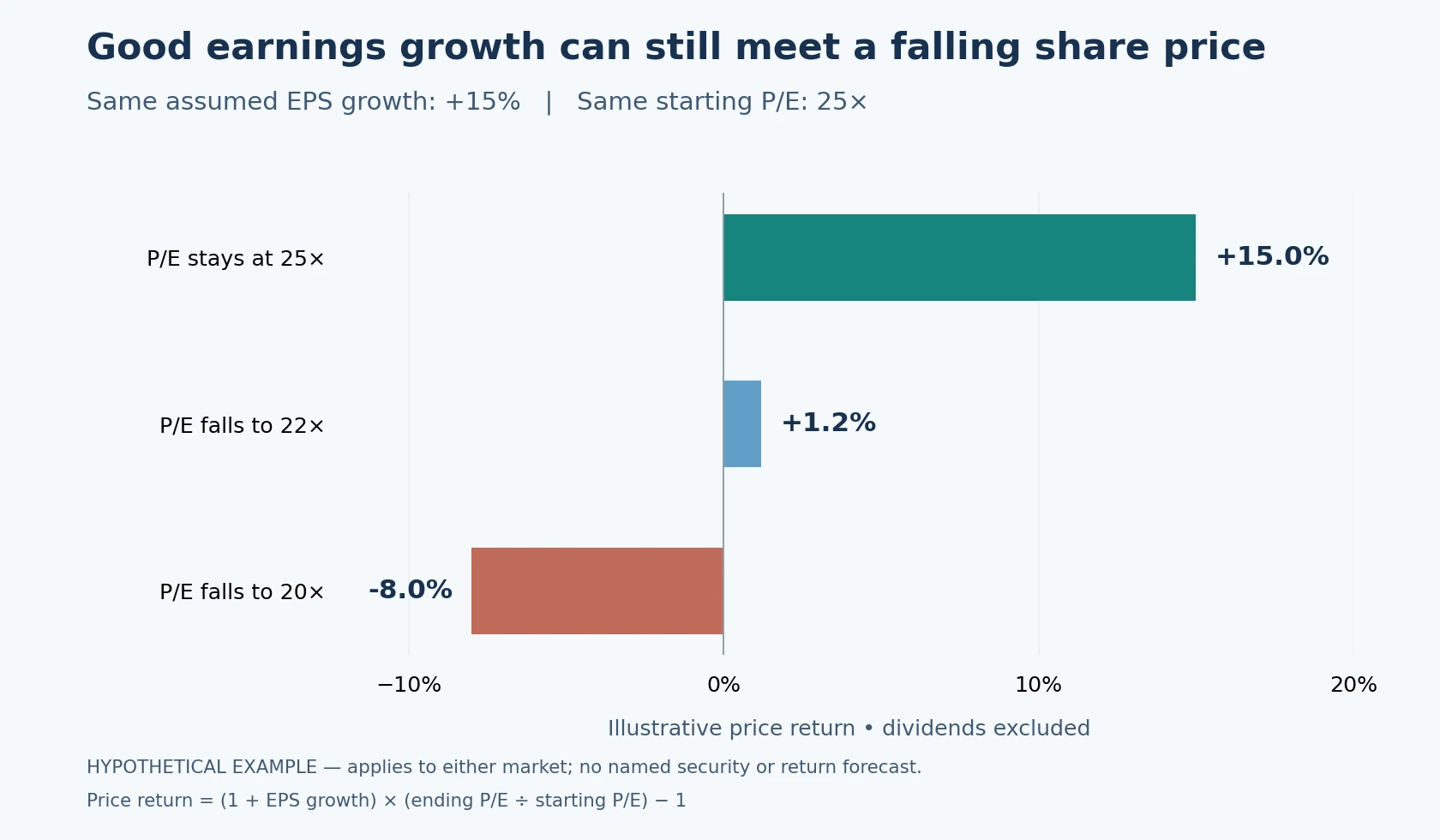
This calculation explains why a sector can deliver impressive operating growth and still disappoint investors. Compare valuation with realistic earnings, cash generation and financing needs. A low P/E is also unhelpful when profits are temporarily inflated or structurally declining.
What could change the sector outlook?
| Condition | USA research implications | India research implications |
|---|---|---|
| AI spending converts into customer cash flow | Technology suppliers and selected industrial enablers may benefit. | Power equipment and digital infrastructure suppliers may gain orders; check execution. |
| AI budgets slow or returns disappoint | Technology and related construction orders may face downgrades. | Test whether each supplier also has customers outside the data-centre theme. |
| Oil remains costly and yields stay high | Financing and valuation pressure could offset growth; energy-company outcomes depend on costs too. | Review input costs, currency exposure, funding and household affordability. |
| Inflation eases without a severe slowdown | Lower financing pressure may help, provided earnings remain sound. | Rate-sensitive demand and project economics could improve; deposit and lending repricing still matter. |
These mechanisms are questions to monitor. They do not imply that a central bank must cut rates or that oil must fall. Update the thesis when evidence changes.
How to research sector ETFs in each market
A sector view becomes an investment only through a specific product and price. Read the issuer's dated holdings, index methodology and costs. A fund labelled technology may have limited exposure to industrial AI suppliers; a power-related fund may hold utilities rather than equipment makers.
- Concentration: measure the largest holdings and overlap with existing broad-market funds. Several fund names can conceal the same exposures.
- Valuation: compare consistent P/E or P/B definitions. Do not equate an ETF's aggregate multiple with the simple average of company ratios.
- Implementation: examine liquidity, bid–ask spreads, tracking difference and any premium or discount to net asset value.
- Currency: an Indian investor's rupee return on a US investment also depends on USD/INR, costs and tax treatment.
Investor.gov explains that narrow sector funds may not provide broad diversification. Portfolio choices should fit the investor's time horizon and tolerance for loss. [6]
A quarterly checklist for 2027
- Record the thesis, starting valuation and information date before investing.
- Compare reported orders or sales with the previous quarter's expectations.
- Check margins, cash collection and balance-sheet changes alongside headline growth.
- Review earnings revisions: is confidence improving, or merely the share price?
- Recalculate total sector and currency exposure across the portfolio.
- Identify what would invalidate the thesis; do not keep moving that condition after disappointing results.
Our present view: US industrial enablers and profitable AI businesses, and India's power-equipment and capital-goods ecosystem, deserve early research attention. Selected financial businesses and healthcare can broaden the watchlist. The final decision depends on company quality, valuation and portfolio fit—not the sector label.
Explore USA and India valuations separately
Use the relevant dashboard to compare available valuation metrics. Check the accepted snapshot date and missing values first; this article's research date does not certify that dashboard figures are current. Use issuer holdings and company filings for the latest underlying details.
Sources and methodology
- J.P. Morgan Asset Management: Where to broaden out in equity allocation?, 16 November 2026. Institutional outlook, including US technology and infrastructure themes.
- State Street Investment Management: Sector Market Perspectives, Q4 2026, 6 October 2026; sector views dated 28 September 2026.
- Invesco: 2027 Investment Outlook — India Equities, 11 November 2026. Manager views and conditional themes, not guaranteed outcomes.
- Reserve Bank of India: Services and Infrastructure Outlook Survey, Q2 FY2026–27, 7 October 2026. Qualitative company expectations extend through Q1 FY2027–28.
- Reserve Bank of India: Sectoral Deployment of Bank Credit — September 2026, 30 October 2026. See the release's coverage and reporting-date notes.
- Investor.gov: Asset Allocation and Diversification. Investor education on concentration, time horizon and risk tolerance.
For educational and informational purposes only. This is not personalised investment advice or a recommendation to buy or sell a security or fund. Investments can lose value. Consider your circumstances and consult a qualified adviser when appropriate.