How Interest Rate Hikes Affect Stock Markets: USA and India in 2026
Higher interest rates change the price of money. That can put pressure on company profits and stock valuations, but the market response also depends on earnings, inflation and what investors already expected. Recent decisions in the USA and India show why the rate announcement is only the beginning of the analysis.
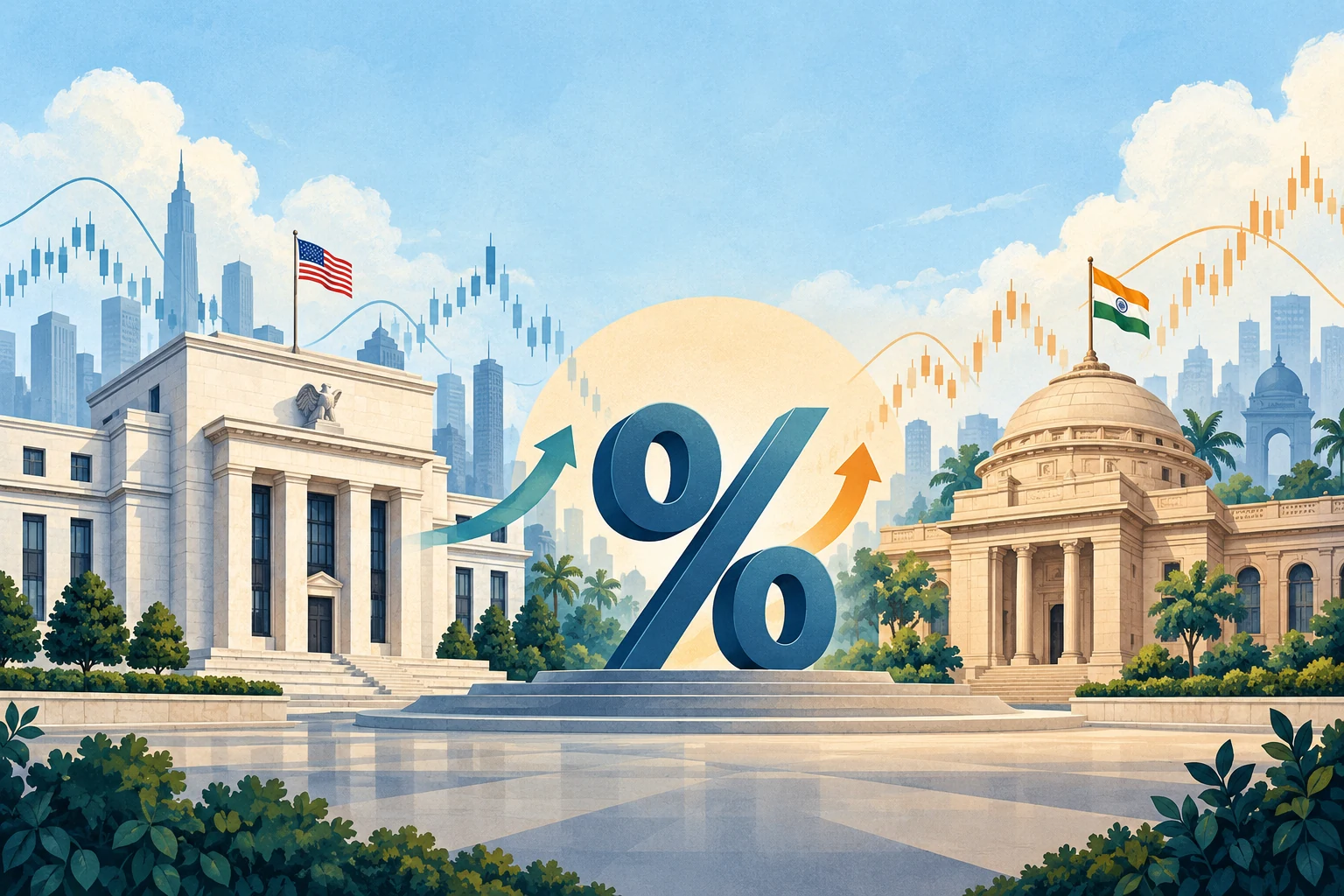
Recent rate increases in the USA and India
In India, the relevant policy benchmark is the RBI repo rate. In the USA, this discussion refers to the Federal Reserve’s target range for the federal funds rate. They are different policy instruments; “repo rate” should not be used as the name of the Fed’s main policy benchmark.
| Market and decision date | Change | Rate after the decision |
|---|---|---|
| USA · 16 September 2026 | Federal funds target range raised by 25 basis points | 3.75–4.00% [1] |
| India · 7 October 2026 | Repo rate raised by 25 basis points | 5.50% [2] |
A 25-basis-point increase means a rise of 0.25 percentage points. The Fed pointed to elevated inflation. The RBI also moved its policy stance to calibrated tightening, indicating that its future decisions would depend on the evolving inflation and growth outlook. These are dated decisions, not a forecast of the next meeting.
How higher rates reach the stock market
Policy rates influence financial conditions rather than setting every company’s borrowing rate directly. The Fed explains that changes can affect credit costs, spending and exchange rates. The timing and size of the effect vary. [3]
1. Future earnings can receive a lower present value
A stock’s valuation reflects expectations about future cash flows. When investors require a higher return, those future cash flows are worth less today, assuming the earnings outlook is unchanged. Businesses whose expected profits lie far into the future can be particularly sensitive.
For a simple hypothetical example, a cash flow of 100 due in one year has a present value of about 92.59 at an 8% discount rate, and 91.74 at 9%. This demonstrates the valuation arithmetic; neither discount rate is the current Fed or RBI policy rate, and the example does not predict any stock’s price.
2. Borrowing costs can weigh on profits and demand
A business refinancing debt at a higher rate may face a larger interest bill. Households facing more expensive credit may delay large purchases. The impact depends on debt levels, fixed versus floating rates, refinancing dates and a company’s ability to maintain margins.
3. Bonds and deposits can become more competitive
Higher available yields can change the return investors require from equities. Compare an equity dividend yield with other income opportunities carefully: dividends can change, share prices can fall, and an equity investment does not provide the same repayment promise as a bond or deposit.
4. Currency and capital flows can affect international returns
Changes in relative interest rates can influence the appeal of assets across countries and exchange rates. [3] A stronger dollar can change the return on a US ETF when measured in rupees. Fed tightening can also influence Indian markets through global funding conditions, although a rate hike alone does not establish that foreign investors will withdraw money.
What to watch in USA ETFs
The following are analytical considerations, not predictions for specific funds. A growth-focused ETF may be sensitive to changes in the valuation of distant earnings. Real-estate exposure may face refinancing pressure. Banks have a mixed picture: higher lending yields can help, while more expensive deposits, weaker loan demand and credit losses can offset that benefit.
A broad US ETF combines different businesses, so examine its sector weights, major holdings and valuation measures together. A high P/E deserves a closer look at earnings expectations; a lower P/E can reflect slower expected growth or greater business risk.
What to watch in Indian indices and ETFs
The RBI decision directly concerns India’s monetary conditions. For research into Indian equities, examine credit-dependent demand in housing and automobiles, financing costs at leveraged companies, and the balance between lending income and funding costs at financial firms. Loan rates do not necessarily reset immediately or by the full policy-rate change.
An index’s response depends on its constituents. A financial-sector index, a broad-market index and an international or commodity ETF can have very different exposures. Use the separate Indian indices dashboard and Indian ETFs dashboard to keep those comparisons clear.
Why stocks can rise after a rate hike
Markets react to new information. An expected increase may already be reflected in prices; the announcement can matter less than a change in guidance about future rates. Earnings news, inflation trends and investors’ required risk compensation can also dominate the day’s response. New York Fed research examines this distinction by studying unanticipated policy changes. [4]
For example, a widely anticipated hike accompanied by less restrictive guidance than feared could coexist with rising stocks. Conversely, unexpectedly persistent inflation could weigh on valuations even without a fresh hike. These are possible scenarios, not descriptions of what happened on either decision day.
Using valuations in your research
Start with the relevant USA ETF or Indian market dashboard, then compare similar exposures. Check P/E, P/B and dividend yield where applicable, alongside the fundamentals date and available risk measures. Historical price cheapness provides price context; it does not establish intrinsic value or a guaranteed recovery.
A lower price after a rate announcement may improve a valuation ratio, but it can also reflect weaker expected earnings. Before drawing a conclusion, check whether the price and fundamentals describe the same period. Our ETF valuation guide explains how these measures fit together.
Explore the market behind the headline
Use valuation and risk measures to ask better questions about the holdings behind an index or ETF.
Sources and verification
- Federal Reserve: FOMC statement, 16 September 2026.
- RBI: Monetary Policy Committee resolution, 5–7 October 2026.
- Federal Reserve: Monetary policy goals and transmission.
- New York Fed: What Explains the Stock Market’s Reaction to Federal Reserve Policy? Historical research; its findings are not a forecast for 2026.
This article provides financial education and general market analysis, not personalised investment advice. Policy figures are verified as of 11 October 2026; later decisions may change them. Investments involve risk, including loss of capital.